A 38-minute investigation of how sexagesimal place value shaped calculation, using YBC 7289 to separate surviving evidence from modern explanation.
Driving question: How does a number system shape calculation?
Objectives
State the place-value scale of a sexagesimal numeral.
Decode and encode a short sexagesimal numeral when its scale is shown.
Explain division by a regular number as multiplication by its reciprocal.
Separate marks on an artifact from modern notation, derivation and reconstruction.
Prerequisites: Decimal place value, fractions and the Pythagorean theorem. No prior history of mathematics is required.
Section 1 of 9 · 38-minute core sequence
Section 1 · 3 min
Observe the tablet
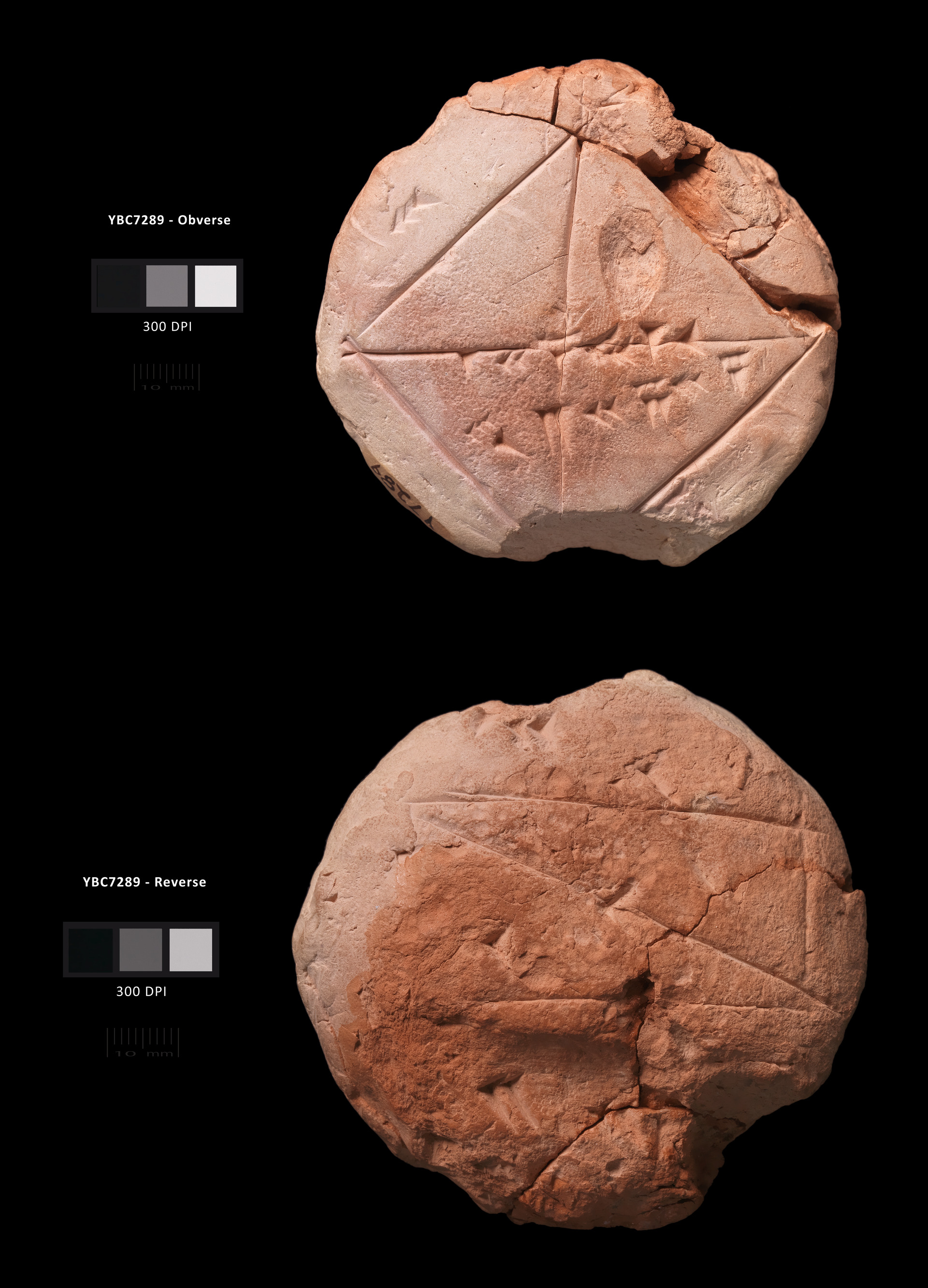
YBC 7289 is an Old Babylonian clay tablet. Begin with what is visible: a square, two diagonals and grouped wedge marks. Do not name the numbers yet.
An artifact can support an observation before it supports an interpretation. The photograph records the surviving tablet; our normalized sign diagrams are teaching reconstructions.
YBC 7289 · YPM BC 021354. Photograph: Urcia, A., Yale Peabody Museum; combined image: Theodor Langhorne Franklin. Source · CC0. Cropped to the obverse. View original photograph ↗
Reveal: Possible observations: a square, crossing diagonal lines, and several groups of marks. None of these observations yet says what a number measures.
Section 2 · 6 min
Build a base-60 place-value system
A normalized teaching diagram uses one sign for 1 and another for 10. Repeated signs build the values within one place. The ancient impressions varied; the diagram is not a claim that every wedge had one identical shape.
Successive places have values …, 60², 60¹, 60⁰, 60⁻¹, 60⁻², …. In modern transcription, 1,3 means one group of sixty and three units: 1 × 60 + 3 = 63. The comma is modern punctuation.
Try reading 1,12 and 2,5, then encode 125. Since 125 = 2 × 60 + 5, its sexagesimal transcription is 2,5.
Reconstruction · base sixty
Read the places
× 601
× 600
Modern transcription2,1760 = 13710
2 × 60^1 + 17 × 60^0
Schematic signs, modern punctuation. “Empty” is an explanatory label, not an Old Babylonian zero sign. Changing the point changes our interpretation of scale.
Reveal: 1,3 = 63; 1,12 = 72; 2,5 = 125; and 125 is written 2,5 when the right-hand place is units.
Section 3 · 6 min
Fractions and reciprocals
Places can continue to the right of the units place. We write 0;30 = 30/60 = 1/2. The semicolon is a modern transcription convention, not a symbol pressed into the tablet.
Multiplying by 0;30 divides by 2 because 2 × 0;30 = 1. Reciprocal tables made many divisions into multiplications, a natural fit for a positional base-60 system.
Reveal: 0;30 = 30/60 = 1/2, so multiplying by 0;30 has the same effect as dividing by 2.
Section 4 · 3 min
Calculate 37 ÷ 6
Use the reciprocal 1/6 = 0;10. Six groups of ten sixtieths make one whole.
Then 37 ÷ 6 = 37 × 0;10 = 6;10. In modern fraction notation, 6;10 = 6 + 10/60 = 6 + 1/6.
Work silently for three minutes before requesting a hint. Read A as four consecutive sexagesimal places and write an exact place-value sum. Then conjecture what A might describe.
Treat A and B as two undecoded inscriptions at first. The staged reveal preserves the distinction between decoding marks, finding a numerical relationship and interpreting what the numbers mean.
YBC 7289 · YPM BC 021354. Photograph: Urcia, A., Yale Peabody Museum; combined image: Theodor Langhorne Franklin. Source · CC0. Enlarged obverse detail. View original photograph ↗
YBC 7289 inscriptions · schematic reconstruction
A
B
Read each group from left to right. Choose the scale and interpretation yourself. These normalized teaching signs are not a facsimile.
Reveal: Hint: begin A at the units place. Then A = 1 + 24/60 + 51/3600 + 10/216000. Finally, B = 42;25,35 = 30A.
Section 6 · 3 min
A modern geometric bridge
For a modern unit square, the Pythagorean theorem gives d² = 1² + 1² = 2, so the positive diagonal length is d = √2.
This derivation explains why the decoded value is relevant to a square. It is our modern explanatory bridge. It does not claim that YBC 7289 contains Greek notation, this proof, or a recorded algorithm for producing the approximation.
Reveal: d² = 2 and d = √2. The equation is a modern derivation; the tablet is the artifact evidence.
Section 7 · 5 min
A smaller and a larger number
A problem associated with YBC 6967 asks for a smaller and a larger number. Their difference is 7, and at the scale used here their product is 1,0 — that is, 60 in decimal notation. A rectangular area story can help us picture the problem, but that setting is a modern classroom adaptation.
Try factor pairs first. Then compare your method with a translated procedure: halve the difference, square it, add the product, take the square root, then add and subtract the half-difference.
Reveal: Half the difference is 7/2 = 3.5. Its square is 12.25; add 60 to get 72.25; √72.25 = 8.5. Then 8.5 + 3.5 = 12 and 8.5 − 3.5 = 5. Check: 12 × 5 = 60 and 12 − 5 = 7.
Section 8 · 3 min
Evidence and explanation
Artifact evidence includes the surviving layout and marks. Reading those marks as sexagesimal numbers is a scholarly interpretation expressed through modern transcription. The unit-square equation is a derivation. A proposed square-root algorithm is a reconstruction unless the procedure itself is documented.
Plimpton 322 can prompt an open question about the purpose of a mathematical table, but contested interpretations should remain questions rather than settled labels.
Reveal: Evidence claim: the tablet records grouped marks beside a square diagram. Mathematical claim: 1;24,51,10 closely approximates √2. The connection is an interpretation supported by the numerical and geometric relationship.
Section 9 · 1 min
Return to the question
Base 60 changes the size of each place and makes many useful fractions terminate. A reciprocal table turns division into multiplication. These are connected features of a calculation system, not isolated tricks.
Exit recall: state the place values in 1;24, explain one step in 37 ÷ 6, and label one statement from today as artifact evidence, derivation, numerical experiment, reconstruction or open question.
Reveal: Its positional scale organized large numbers and fractions in one notation, while terminating reciprocals supported multiplication-based division.
Enrichment
Choose at most one extension when time allows. Neither is required for the core objectives.
Numerical accuracy of YBC 7289
The tablet value is 1;24,51,10 = 30,547/21,600 ≈ 1.414212963, while a modern calculation gives √2 ≈ 1.414213562. The absolute error is about 5.994 × 10⁻⁷. This is a modern numerical experiment: closeness does not identify the undocumented method that produced the tablet value.
Square-root iteration reconstruction
Starting with x₀ = 3/2, the modern reconstruction xₙ₊₁ = (xₙ + 2/xₙ)/2 gives 17/12 and then 577/408. It demonstrates how an approximation can improve, but it is not a procedure written on YBC 7289.
Prepare for class
Open this on the teacher computer while connected. It stores and verifies the core same-origin pages, scripts, styles, fonts and images in this browser. Browser cache can be cleared by device policy, so also print the teacher fallback.
Urcia, A. · Yale Peabody Museum of Natural History; combined image by Theodor Langhorne Franklin. 2019.
Yale Babylonian Collection · YPM BC 021354 / YBC 7289
Provenance and reuse
CC0 1.0 Universal Public Domain Dedication, as recorded on the file page. The original photograph is served locally. The observation view crops to the obverse; the investigation view enlarges a detail with CSS. No marks have been redrawn. The unmodified combined image remains available.
Jens Høyrup · Max Planck Research Library. 2017. Chapter 3: The Fundamental Techniques for the Second Degree; section YBC 6967.
Yale Babylonian Collection · YBC 6967
Provenance and reuse
Linked source; no third-party media reproduced. Original Atlas diagrams are labeled reconstructions. Consult the institution for reuse of its images.
Accessed 2026-09-20.
Diagrams and teaching explanations are original Atlas reconstructions unless otherwise identified. Source checking and automated tests do not imply a recorded human historical review.