Sixteen historical exhibits and The Big Bang Theory: Friendship, Science & Everyday Life. Mathematics activities for Grades 7–11.
Use the browser print dialog to save a PDF or print. This guide remains readable without JavaScript.
How to read this guide
Evidence, translation, and model
Each exhibit identifies its historical evidence, the limits of its interpretation, and a separately labelled modern mathematical translation. The five browsing series make comparison easier; they do not claim a sequence of cultural replacement or a documented transmission route.
Ancient Mesopotamia · Old Babylonian, 19th–17th century BCE
Historical evidence
A school tablet links a square-diagonal diagram with the sexagesimal value now read as an approximation to √2. The numerical agreement is documented; its exact ancient derivation is not settled.
Historical method
A sexagesimal value is written beside a square-diagonal diagram.
Modern teaching translation
Evaluate 1 + 24/60 + 51/60² + 10/60³ and compare it with √2.
Try: The full reconstructed value differs from √2 by about 0.00000060.
Evidence boundary
There is no printed cuneiform decimal separator, and the calculation method is uncertain.
A. Urcia / Yale Peabody, combined by Theodor Langhorne Franklin · CC0 1.0. The image is contextual evidence; the mathematical diagram is a separate modern teaching model.
The Rhind Mathematical Papyrus preserves worked calculations. Distinct unit-fraction sums provide a modern notation for a historical practice.
Historical method
Worked numerical procedures use unit-fraction conventions.
Modern teaching translation
Use exact rational arithmetic to verify sums of distinct unit fractions.
Try: 2/5 = 1/3 + 1/15.
Evidence boundary
The source texts copied by the scribe and the status of every reconstruction are not settled by one catalogue.
Thomas Eric Peet, 1923 transcription/reconstruction · Public domain mark. The image is contextual evidence; the mathematical diagram is a separate modern teaching model.
Ancient China · Han-era text with later commentary
Historical evidence
The eighth chapter of The Nine Chapters arranges quantities on a counting board. This exhibit shows a fixed modern reconstruction using exact arithmetic.
Historical method
Arrange coefficients and constants with counting rods and reduce columns.
Modern teaching translation
Solve a fixed three-equation system through exact elementary elimination.
Try: The fixed system gives x = 37/4, y = 17/4, z = 11/4.
Evidence boundary
No single composition date is settled, and no physical board for this problem is claimed.
Completing the Squarehttps://old.maa.org/press/periodicals/convergence/completing-the-square-from-the-roots-of-algebra-a-mini-primary-source-project-for-students-of
Completing the Square sourcehttps://old.maa.org/press/periodicals/convergence/completing-the-square?device=mobile
Islamic World · P0
A Planispheric Astrolabe
Islamic world / Iran · Safavid period, 1654–55
Historical evidence
A planispheric astrolabe models the sky on a flat instrument. The interactive rete is an idealized contemporary teaching model, not a reconstruction of a historical observation.
Historical method
A moving celestial component and a latitude-specific plate support angular readings.
Modern teaching translation
Project an illustrative point and compute altitude from latitude, declination, and hour angle.
Try: At φ = 35°, δ = 20°, H = 0°, the altitude is 75°.
Evidence boundary
Instrument practices varied; the simulator does not infer a real observer, date, place, or intended use.
Metropolitan Museum of Art, object 63.166a–j · CC0 / Met Open Access. The image is contextual evidence; the mathematical diagram is a separate modern teaching model.
From finger to machinehttps://www.arts-et-metiers.net/musee/du-doigt-la-machine-le-calcul
The Big Bang Theory
Friendship, Science & Everyday Life. Six mathematics topics and four programme introductions occupy twenty frames. Programme facts, sourced models and original teaching adaptations are identified separately.
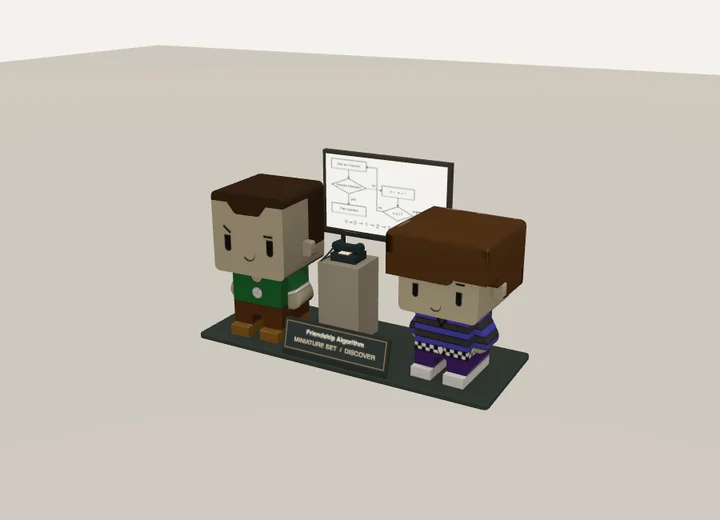
Sheldon wants to befriend Barry Kripke and turns the task into a flowchart. A phone call moves from a meal to a hot drink, then to recreational interests.
When the search for a shared interest repeats, Howard adds a loop counter and an exit to the least objectionable activity. This repairs the procedure, without guaranteeing a friendship.
Curator mathematical extension
A decision chooses a branch. A retry returns to a previous state. A bounded counter supplies a reason to stop.
Read the flowchart
Rectangles perform actions; diamonds test conditions. Follow the labelled yes/no arrow from each decision. A dashed wait requires an external callback, not another computation step.
Describe a state
The current node, position in the interest list and counter determine the next step in a fixed script. The display also counts the interests checked. The three interests are climbing, music and games.
Find the loop
Without a counter, a script with no shared interests returns to the same node and interest position. Since its future inputs are unchanged, the same transitions repeat. Reaching a display cap alone would not prove this.
Count after a failure
Initialize n to zero. After each unsuccessful interest, add one; then compare n with the limit L. For L = 3 the failures are counted 1, 2, 3, and the third failure ends the attempt.
n0=0,n←n+1,n≥L⇒exit
Why the repair terminates
At the start of a permitted retry, L − n is a nonnegative integer. A failed interest decreases it by one; a match ends the call earlier. Thus at most L interests are checked. This bound counts interest checks, not every arrow in the flowchart.
R=L−n,R←R−1,0≤n≤L
A program outcome
Agreeing a meal, drink or activity ends one scripted call. Ending an attempt is a different outcome. Neither establishes that two people have become friends.
Scope and limits
The diagrams and five scripts are exhibition adaptations, not an exact reconstruction of the programme prop.
The counter bound applies to interest checks after the answered call reaches the interest branch. Waiting for a callback has no promised time bound.
A finite pause is reported as a demonstration cap, separately from a repeated deterministic state.
Tea is the fixed drink in this teaching script. Friendship and a person’s wishes are not mathematical outputs.
David Saltzberg supplied accurate science for the set. A portion of the 73 uniqueness proof later appeared on a whiteboard.
Curator mathematical extension
Checking many primes can reveal a conjecture. Pomerance and Spicer’s argument establishes uniqueness for infinitely many candidates.
What the search checks
Write p_n for the nth prime. A Sheldon prime has index n equal to the product of its decimal digits, and reversing its digits gives the prime at the reversed index. The binary palindrome is a separate curiosity.
n=∏digits(pn),rev(pn)=prev(n)
Three different claims
A calculation verifies one case; a conjecture proposes a general rule; a proof supplies a valid general argument.
A finite limit
Testing every prime below a chosen number leaves infinitely many possible later primes.
A documented appearance
Dartmouth reports that a portion of the ten-page proof appeared in the 18 April 2019 broadcast.
Scope and limits
The wall image is not transcribed as a complete proof.
Set decoration alone is not mathematical evidence; the paper is the source for the theorem.
Scientists, neighbours and a shopkeeper share a world of work, games and everyday negotiations. These introductions describe recurring roles across the series; relationships and careers develop over time.
Sofa conversations, household rules and visits across the hall turn a small collection of rooms into a social world. Repeated settings let viewers recognise a situation before the dialogue begins.
Sheldon’s spot
Warner Bros. identifies Sheldon’s sofa seat as a landmark of the original set.
The sofa is extracted from iansed’s fan model. Its label marks a reference to the show, not a new seat control.
Roommate agreement
In S3E22, Leonard encounters Sheldon’s terms for sharing the apartment.
The cover here is an original exhibition label; it does not reproduce or invent contract clauses.
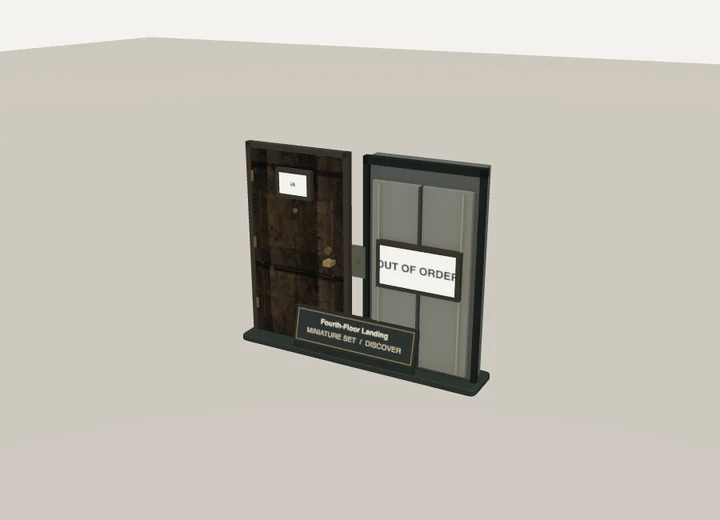
4A door
The number identifies the apartment; the knocking routine makes the threshold memorable.
Miniature door and number plate are exhibition interpretations.
Broken elevator
The out-of-order elevator helps make the stairs part of everyday encounters.
The model is static scenery. The show’s later changes are outside this early-series interpretation.
The exhibition pairs play with everyday acts of care. The same friends who debate rules also negotiate the meaning of a gift or gather over takeaway food.
Dice
The dice invite a comparison of possible outcomes and observed rolls.
The teaching simulation assumes fair dice and independent rolls; the tabletop is a miniature adaptation.
Three-player chess
Sheldon presents a chess variant for three players in S4E22.
Our three-colour board illustrates turn order only. It is not a reconstruction of the full on-screen rules.
Comic rack
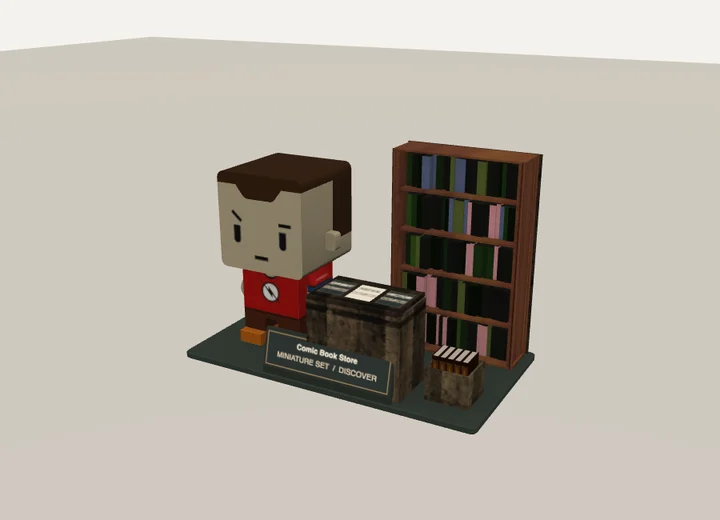
The shop’s shelves recall Stuart’s role as a comic-book retailer.
Sourced shelving with original abstract cover designs. These are not reproduced commercial comics.
Book boxes
Boxes and browsing stock give this corner the character of a small shop.
Decorative inventory, not a catalogue of issues featured in the programme.
Gifts and expectations
S2E11 turns Sheldon’s attempt at a balanced gift exchange into a surprise.
Explore uses explicitly labelled teaching prices. It does not assign a market price to affection or a treasured keepsake.
Science consultant David Saltzberg reviewed scripts and prepared equations for the set’s whiteboards. Research could become background detail without becoming the episode’s plot.
The science consultant
Saltzberg’s role included checking scientific dialogue and consulting other specialists when needed.
UCLA’s account was published in 2014. Cast member Mayim Bialik also holds a doctorate in neuroscience.
The Sheldon conjecture
Carl Pomerance and Chris Spicer proved that 73 is the only prime satisfying their Sheldon-prime conditions.
The paper, not the television image or a finite search, is the source for the theorem. Explore the original proof exhibit for the exact conditions.
Amy and Bernadette broaden the programme’s scientific community. Books, instruments and a board suggest work continuing beyond the laboratory.
DNA model
The double helix evokes the life sciences associated with Amy and Bernadette.
An original decorative helix, not a molecular structure or an identified prop from an episode.
Telescope
Astronomy connects this display to Raj’s field of research.
The complete instrument and tripod were extracted from iansed’s credited apartment model and uniformly reduced. Adjacent laboratory vessels are by Jiří Ptáček / Poly Haven (CC0). This display does not simulate working optics.
Stuart’s comic-book shop gives the group another place to browse, talk and meet. A shared interest can offer an opening without guaranteeing a friendship.
Comic rack
The shop’s shelves recall Stuart’s role as a comic-book retailer.
Sourced shelving with original abstract cover designs. These are not reproduced commercial comics.
Book boxes
Boxes and browsing stock give this corner the character of a small shop.
Decorative inventory, not a catalogue of issues featured in the programme.
The official studio tour highlights the apartment doorway, Sheldon’s distinctive knock and the broken elevator. The landing becomes a recognisable transition between scenes.
4A door
The number identifies the apartment; the knocking routine makes the threshold memorable.
Miniature door and number plate are exhibition interpretations.
Broken elevator
The out-of-order elevator helps make the stairs part of everyday encounters.
The model is static scenery. The show’s later changes are outside this early-series interpretation.
Original miniature interpretations with fan-created characters and furniture. Open a set label to discover its two featured props. The twenty wall frames explore mathematics and life in the programme.
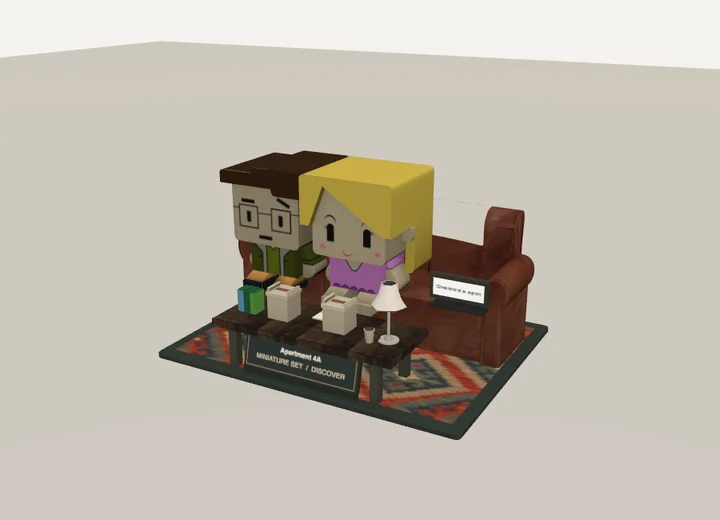
Leonard and Penny on a sofa adapted from iansed’s apartment, with a coffee table, takeaway boxes and a marked place for Sheldon. A miniature, not a full set reconstruction.
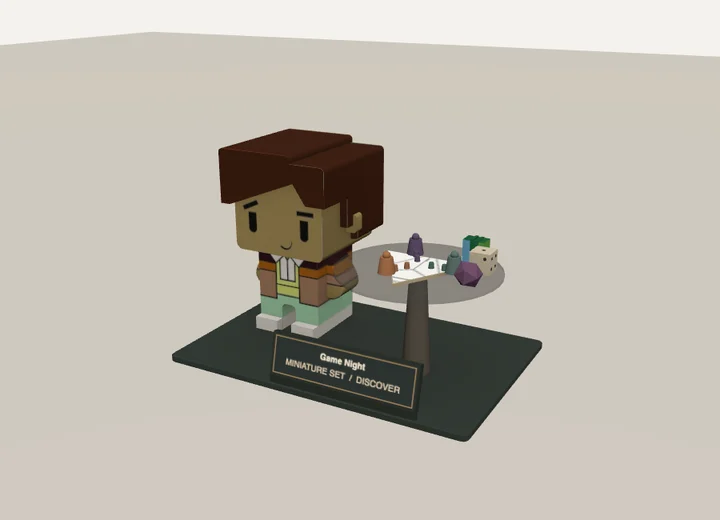
Raj, dice and an original three-player teaching board. The board models turn order; it does not claim to reproduce the programme’s complete chess rules.
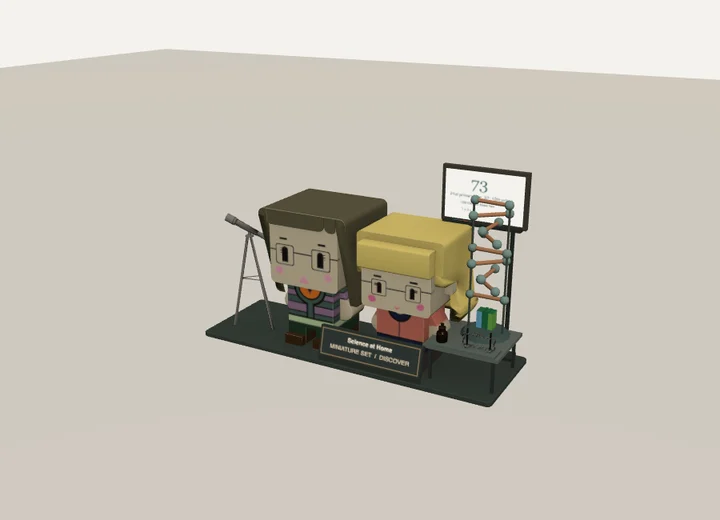
Amy and Bernadette with an original DNA model, telescope and a whiteboard linked to 73. These props connect the show’s science setting to the mathematical exhibition.
Stuart beside a bookshelf adapted from the apartment source, original comic boxes and a small counter. Book spines are abstract colours, with no reproduced covers.
A miniature door marked 4A and a broken elevator recall the apartment landing. Original simplified models keep the entrance and frame viewing positions clear.
Characters: gozdemrl. Selected furniture: iansed. Both sources label their models CC BY 4.0. Adaptations: extraction, miniature scale, posed cast, original furniture UVs, baked contact shading and original teaching props. Laboratory bottle and rack: Jiří Ptáček / Poly Haven, CC0. Powered by Poly Haven. Asset record.
Mathematics labs
These default diagrams and statements remain readable without JavaScript. The interactive reading view contains the full reasoning and experiment controls.
Calculate graph Laplacian eigenmodes and use them to follow heat diffusion through a weighted network.
theorem
The graph Laplacian is positive semidefinite.
vTLv={i,j}∈E∑wij(vi−vj)2≥0
Conditions: A finite undirected graph. Nonnegative edge weights and no self-loops. Each undirected edge appears once in the sum.
theorem
The multiplicity of the zero eigenvalue equals the number of connected components.
Conditions: Only positive-weight edges count as connections. L = D − W is the unnormalized Laplacian.
derivation
Each Laplacian eigenmode decays at the rate given by its eigenvalue.
u(t)=k=1∑ne−λkt⟨u(0),ϕk⟩ϕk
Conditions: du/dt = −Lu with fixed L. The eigenvectors form an orthonormal basis. No external sources or sinks are added.
theorem
On a connected graph, the second eigenvalue bounds decay toward the uniform mean.
∥u(t)−uˉ1∥2≤e−λ2t∥u(0)−uˉ1∥2
Conditions: The graph is connected and n ≥ 2. Eigenvalues are sorted in nondecreasing order. The bound need not be attained by the selected initial state.
Compare geodesic triangles in a plane, on a sphere and in the Poincaré disk using each model’s own metric.
theorem
A valid constant-curvature geodesic triangle has angle excess equal to curvature times area.
α+β+γ−π=KA
Conditions: A simple, nondegenerate geodesic triangle bounding the stated region. The sphere uses short arcs within a common hemisphere. Angles are in radians.
theorem
The Poincaré disk metric assigns a specific hyperbolic distance to each pair of interior points.
d(u,v)=arcosh(1+(1−∣u∣2)(1−∣v∣2)2∣u−v∣2)
Conditions: |u| < 1 and |v| < 1. Curvature is −1.
numerical experiment
Spherical excess can be compared with an area calculation from the three unit direction vectors.
A=2R2atan2(∣det(a,b,c)∣,1+a⋅b+b⋅c+c⋅a)
Conditions: The valid short-arc spherical triangle selected by this exhibit. The determinant calculation is independent of the angle-sum calculation.
Compare nearby Lorenz trajectories and separate sensitivity to initial conditions from numerical discretization error.
derivation
Three coupled differential equations define the Lorenz initial-value problem used here.
x˙=σ(y−x),y˙=x(ρ−z)−y,z˙=xy−βz
Conditions: The displayed parameters and initial state are fixed for each run. The coordinates and time are model variables.
derivation
The origin is an equilibrium; when ρ > 1 there are two further equilibria.
(x,y,z)=(±β(ρ−1),±β(ρ−1),ρ−1)
Conditions: σ > 0 and β > 0. Matching signs are used for x and y. ρ > 1 for the nonzero pair.
numerical experiment
The distance between two computed trajectories measures separation for this particular run.
d(t)=∥uε(t)−u(t)∥2
Conditions: Both trajectories use the same solver, step and parameter values. Only the first initial coordinate differs by ε. A finite trajectory comparison is not a proof of all properties of chaos.